
October 7-10, 2026
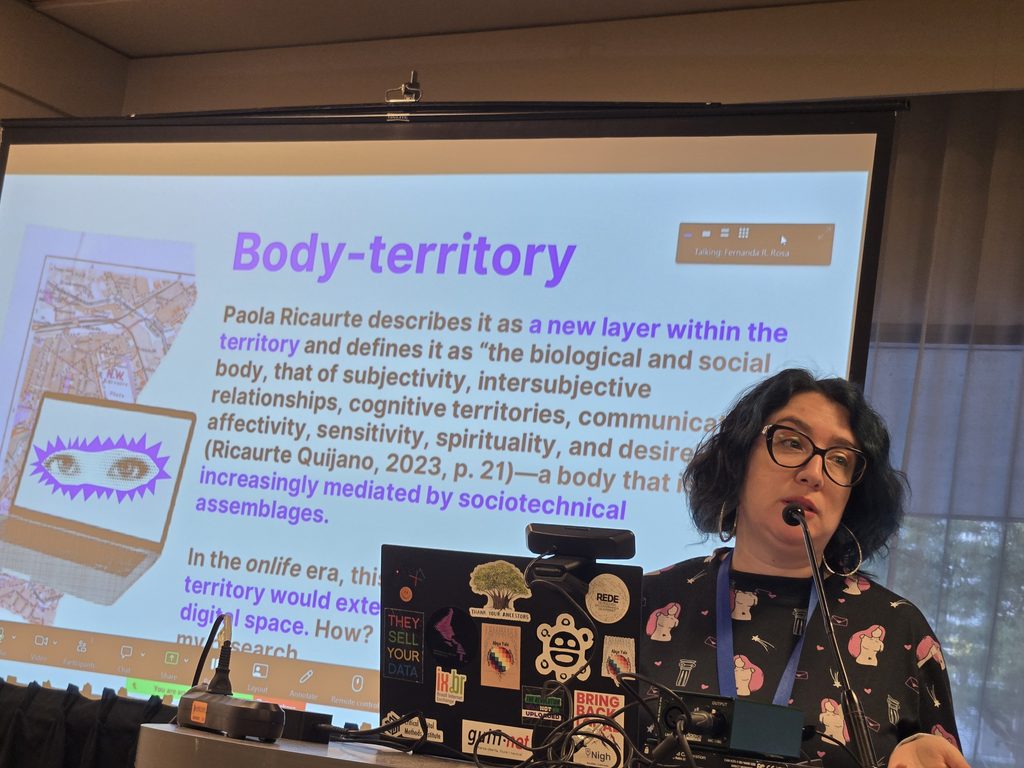
Panel: Code, Bodies, and Territories: Digital Colonialism and Resistance in Latin America
Organized by Fernanda R. Rosa, Virginia Tech; Diego Vicentin; Carolina Israel, Federal University of Paraná; Rodolfo Avelino, Insper; Leonardo Cruz, Federal University of Pará
October 10th, 2026
8:00 AM – 5:30 PM
The constitution of modernity is inseparable from scientific narratives that defend universality as a principle of knowledge production. Consequently, the Western technical incorporation into the bodies and territories, as taught by Indigenous and Black peoples, has become a systematic mechanism of subalternization of traditional, local, popular, and dissident knowledge. The forms of resistance that historically emerge involve multiple strategies that encompass both the preservation of knowledge, memory and identities and the technical appropriation following different sociotechnical arrangements. Given these guiding principles and the current techno-productive transformations that emerge with AI, this panel constitutes a space-time to address the relationships between digital technologies, including code, infrastructure, and their governance, as devices of bodily, epistemic, ontological, and territorial domination in Latin America, as well as the forms of resistance in their multiple configurations. Indigenous practices, maintained for centuries on the continent, are the prime example of such resistance, to which the struggles of Black and maroon populations, women, LGBTQ+ people, people with disabilities, those under social vulnerability, among others, are added.
Despite techno-epistemic hegemonies, Indigenous and Decolonial Science and Technology Studies (STS) emerge as a possibility for repositioning academic research in a way that is committed to a pluriversal future that respects multiple cosmotechnics and symmetrical dialogue with diverse forms of knowledge. In line with this horizon, this panel establishes among its objectives: To provide a space for debate focused on the possibilities of techno-scientific (re)making in dialogue with the pluriversality of knowledge and technologies; To reimagine code, infrastructure, and governance of digital technologies mediating human and nonhuman relations; To socialize experiences, research, and actions that aim at counterpointing hegemonic digital socio-technical relations; To share knowledge and experiences about the characteristics of Latin American techniques in the embodiment of the digital, highlighting the relationships between technique, territory, and body.
Information, Computing and Media Technology; Decolonial and Postcolonial STS; Feminist STS
Session 1
8:00 – 10:00 AM
Participants:
- A secure empire? Spyware governance and the reproduction of colonial power – Mariana Canto, University of Stirling
- The digital body-territory: a proposal to reveal violence and re-existences in the digital space – Cecilia Ananías Soto, Karen Vergara (Amaranta NGO)
- Mapping the Feminist Movement: A Transregional Archive of Collective Action, Spatial Memory, and Visual Practice – Selene Yang, Wikimedia Foundation
- Listening Otherwise: Kayapó Media Practices and Digital Governance in a Patchy Terrain – Camila Coelho, Purdue University
- Decolonial Hacktivism and the Territorial Hack: Guacamaya and the Insurgent Geographies of Extractive Capital – Steven Duncan, Columbia University
Session 2
10:20 AM – 12:20 PM
Participants:
- Technoaesthetics as Cosmological Pluralities: On Data Mining and Pattern Recognition in Contemporary Art – Maria Cortez Salviano, University of Campinas (Unicamp)
- Who is Owed Health in the Computer Industry? Redrawing the Contours of Computing via Workers’ Cuerpo-Territorios – Veronica Uribe del Aguila, Rensselaer Polytechnic Institute
- Criptofunk and favela-rooted urban practices: insurgent technopolitics in peripheral territories – Rodrigo Firmino, Pontifical Catholic University of Parana (PUCPR); Andres Luque-Ayala; Gilberto Vieira
- Managing the territories of the South: digital transformation as techno-epistemic domination Carolina Israel, Federal University of Parana
Session 3
01:30 – 3:20 PM
Participants:
- Resisting platform capitalism in the Brazilian urban space: notes from São Luís (MA) – Lucas Seixas, University of Campinas; Lindon Matias
- Concentration in the Cloud and the Consolidation of Digital Colonialism in AI Infrastructures – Rodolfo Avelino, Insper; Joao Eduardo Luisi Vieira
- Tracking tin elsewhere: energy transition, data centers, and fragmented infrastructures seen from the Brazilian Amazon – Vitor Chiodi, Laboratory of Technological Change, Energy and Environment (LABMEM)
- Sociotechnical imaginaries of facial recognition in public security: the case of Smart Sampa Program, São Paulo, Brazil – Maria Vitoria Pereira de Jesus, University State of Campinas (Unicamp)
Session 4
03:40 – 5:20 PM
Participants:
- Body-Territory is not a Concept: The Contributions of Indigenous Women’s Ontologies to STS – Yunuen Torres Ascencio; Rita Simone Barbosa; Bárbara Flores Borum-Kren, Universidade Estadual de Santa Cruz; Ytxaha Pankararu Braz, Organização das Mulheres da Aldeia Cinta Vermelha-Jundiba; Carolina Israel, Federal University of Parana; Andreza Jorge, Virginia Tech; Leo Maia Kijanja, Centro de Prática e Pesquisa Estrela de Angola; Jamille da Silva Lima-Payayá, Universidade Estadual de Campinas; Malely Linares, Universidad Autónoma de Zacatecas; Aline R. S. S. de Souza, Virginia Tech; Paola Ricaurte Quijano, Tecnológico de Monterrey; Fernanda R. Rosa, Virginia Tech; Veronica Uribe del Aguila, Rensselaer Polytechnic Institute; Megan Wiessner, University of Richmond
- Resisting the Bodies-Territories Takeover: Data/Digital Colonialization in the Brazilian AI Plan – Beatrys Rodrigues, Cornell University
- Toward A Cartography Of Epistemic Violences In Latin American Women’s Bodies-Names-Territories On Wikipedia – Alejandra Josiowicz, State University of Rio de Janeiro
- Technopolitical experiments in the face of digital colonization: body and territory – Henrique Parra, Federal University of São Paulo
—
Roundtable: An Alternative Internet is Already Here: Empirical Engagements, Community Work, and STS Intersections in Tech Otherwise
October 8th, 2026
12:20 – 1:30 PM
Presenters:
R.Stuart Geiger, UC San Diego
Janet Vertesi, Princeton University
Nathan Schneider, University of Colorado Boulder
Robert Gehl, York University
Fernanda R. Rosa, Virginia Tech
—
Panel: From Bubbles to Rubbles: Ruins in the Age of AI 2
Organized by Benedetta Catanzariti, University of Edinburgh; Ludovico Rella, Durham University
October 8th, 2026
3:40 – 5:30 PM
Since the public release of ChatGPT, generative AI has entered an accelerated phase of sociotechnical consolidation, marked by the rapid expansion of computational infrastructures, large-scale capital investment, complex debt and financing arrangements, and intensifying present and anticipated energy demands. The scale of these investments, the reliance on leveraged capital, and the increasingly circular financial and infrastructural entanglements among ostensibly competing actors have unfolded alongside growing public skepticism regarding the material and social returns of AI projects. This conjuncture has led commentators to frame generative AI in terms of speculative excess and the possibility of an AI ‘bubble.’
From an STS perspective, however, the question is not only whether such a bubble will burst, but how AI infrastructures reinforce or precipitate particular political-economic arrangements, ecological burdens, and forms of technological dependence. What kinds of infrastructural ‘ruins’ – data centers, energy systems, extractive supply chains, financial instruments – might be left behind if large-scale AI investment contracts? Conversely, if expansion continues, what enduring social, energy, and environmental footprints will be stabilized? Which actors across hardware and software industries, finance, states, and local communities will benefit or bear the costs of these trajectories? And how might the dynamics of the AI bubble be mobilized as an analytic lens for imagining alternative technological paths, governance regimes, and infrastructural futures beyond extractive and growth-oriented models? This panel invites contributions that engage with these questions and critically examine generative AI as a contested sociotechnical formation. This panel seeks abstracts (no more than 250 words) on topics including (but not limited to)
- Ruins of cloud infrastructures and data centers
- Energetic, ecological, and social afterlives of AI systems
- Material residues (chips, minerals, water, labor)
- Infrastructural failures and breakdown
- Resistance, refusal, and post-cloud futures
- Methods for studying decay, maintenance, and infrastructural ruins
Infrastructure; Energy and Extraction; Information, Computing and Media Technology
Session 2
Participants:
- AI Slop: Hidden Aspirational Labor Undergirding the New Audiovisual Malaise of our Algorithmized Media Environments – Alfonso Hegde, University of Southern California
- The Digital Pivot of Colonial Ruins: Marseille’s Grand Port as a Formational Pathway of Big Data’s Informal Empire – MIAO WANG
- Governing volatility in the cloud state – Angus Dowell, The University of Auckland
- Things will get worse: Rates of profit, the empire’s decline, and the AI economy – Nathan Kim, University of Michigan; Justine Zhang, University of Michigan
- The political economy of Mobile AI: data extractivism or privacy as a service? – Diego Vicentin, UNICAMP – Universidade Estadual de Campinas; Gleicyanne Martins; Maria Vitoria Pereira de Jesus, University State of Campinas (Unicamp)
—
Panel: Computing Machinery Supply Chains Across Space, Time, and Method
October 7, 8:00 AM – 12:20 PM
Organized by MC Forelle, University of Virginia; Veronica Uribe del Aguila, Rensselaer Polytechnic Institute
Over the past decade, the computing machinery industry—the sectors involved in designing, developing, manufacturing, and distributing physical hardware from industrial controllers to advanced AI processors—has faced several controversies. These have brought public attention to the environmental and economic impacts of their supply chains understood as extraction sites, factories, and trade agreements the industry depends on. The ripple effects of the chip shortage during the COVID pandemic, the US and EU’s Chip Act, and the rising tensions between China and Taiwan are examples of the computing machinery industry’s infrastructural power, or the power to tear apart people’s lives while remaining invisible.
STS scholars have long taken an interest in the global supply chains that comprise the computing machinery industry. They have paid attention to their materiality, geopolitical dynamics, and sociotechnical imaginaries to unpack how the industry’s transnational configurations perpetuate troubling racial, colonial, neoliberal, and capitalist logic across different industries such as automotive, aerospace, agriculture and computing itself.
Building on this foundation, we invite submissions inquiring how computing machinery supply chains influence, expose, or otherwise involve other sectors of global industry through the lenses of political economy, critical geography and new materialism. We are particularly interested in historical and ethnographic perspectives that help us grasp the role computing technology plays in shaping the organization of industrial supply chains in different sectors.
We will organize these sessions as a combined format panel. Therefore, we invite both full papers and works-in-progress. Full papers will be assembled into a traditional paper presentation session. Works-in-progress will be arranged into a workshop session for participants to share conceptual and/or methodological approaches and challenges and to collaboratively generate new avenues, techniques, and solutions. We ask that WIP submissions provide a clear description of the project in progress, its level of completion, and two or three questions for the session.
Information, Computing and Media Technology; Infrastructure Decolonial and Postcolonial STS
Session 1
8:00 – 10:00 AM
Participants:
- Assembly Required: Development, Semiconductors, and the Maquiladora Interface – Iván Chaar López, The University of Texas at Austin
- Transnational energy systems, e-waste, and the relegation of space – Nneka Udeagbala, University of Michigan
- From Extraction to Computation: Temporal Layers of AI Infrastructure – Catherine Wieczorek, Georgia Institute of Technology; Annabel Rothschild, Bard College
- Assembling Indigenous Technologies : Supply chains of self reliant production in Bangalore (1970-2020s) – Aditi Dey, The New School
- GenAI as a Dispositif of Digital Governmentality: Discourse Evasion in Political Discourse Production in DeepSeek – Zhiyu Bao, Fudan University
Session 2
10:20 AM – 12:20 PM
Participants:
- The Judgment of Thamus: An Exploratory Methodology for Observing How Large Language Models Mediate Knowledge – Patrick McCurdy, University of Ottawa; Chris Russsill, Carleton University
- The Digital Hand: Planning Beyond the Firm via In-Kind Calculation – Autumn Mitchell, University of California, Berkeley
- Photo documentation of infrastructure as a strategy communities employ to shift power – Jenna Burrell, University of Tokyo, Graduate School of Interdisciplinary Information Studies
- Chipping in: Recruitment Rhetoric and Filipino Migrant Labor in the Philippines-Taiwan Semiconductor Supply Chain – Lucy Pei, USC Equity Research Institute; Benedict Olgado, University of the Philippines
- How the Quartz Crucible Became the Crystal Singing Bowl (And What it Can Tell Us About AI Supply Chains) – Owen Marshall, Cornell S&TS and Information Science
- Supplying skills in AI supply chains – Jai Vipra, Cornell University
—
Panel: Critical Studies of Corporate Harm 4
Organized by Daniel Akselrad, University of California, San Francisco; Dan Kabella, University of California San Francisco; Kim Fortun, University of California Irvine; Tim Schütz, University of California, Irvine; Haley Lepp, Stanford University
October 7, 2026
3:40 – 5:30 PM
From Big Tobacco to Big Carbon, corporations have long mobilized expertise to conceal harm, deflect accountability, and reshape public understanding. We invite scholars across STS, history of science, infrastructure studies, environmental studies, and critical public health to examine the material, epistemic, and institutional architectures through which corporations produce ignorance, entrench power, and normalize catastrophes fast and slow.
Building on foundational work in agnotology (Proctor & Schiebinger; Oreskes & Conway), studies of epistemic networks (Galison; Gieryn), disinformation studies (Starbird; West), slow violence and disaster STS (Nixon; Fortun), we approach corporate harm not as episodic negligence but as a systemic condition sustained by denialist infrastructures and industrial-academic partnerships. These practices are embedded in logistical networks, think tanks, and trade associations (Brulle; Farrell). They are bound up in complex cultural infrastructure (Kunda; Turner): studying them means unearthing previously secret communiqués, internal media, and other artifacts of organizational culture to better understand how corporate power is maintained and contested.
Understanding how corporations wield science (and importantly the appearance of science) as an instrument of power—through greenwashing, conflict of interest, and the capture of knowledge centers—becomes an urgent task for STS. We welcome papers addressing corporate harm across industries (tobacco, petrochemicals, opioids, ultraprocessed foods, artificial intelligence, gun fundamentalism, online gambling, Big Flesh, PFAS, and more) examining how corporations weaponize science to manufacture doubt and fend off liability. Moving beyond critique, we also seek contributions that illuminate counter-practices such as undone science, radical archiving, and the reclamation of suppressed knowledges to hold industrial actors accountable.
Studies about the History of Science; Infrastructure; Advocacy, Equity, and Justice
Session 4
Participants:
- Pfizer-Brand Innovation and the Making of International Intellectual Property Standards – Karuna Vikram
- The Making of Ultra-Formulated Opioids: Fentanyl Lollipops and the Weaponization of Pleasure in Pain Relief – Dan Kabella, University of California San Francisco; Kelly Knight, University of California San Francisco; Jessica Ristau; Dorie Apollonio, University of California, San Francisco
- Ignorant Technologies: Big Tech and Systemic Harm Against Gender-Diverse Communities – Jess Reia, University of Virginia; Rachel Leach, University of Virginia
- Inhaling Injustice: Tracing toxic decisions from the UK’s Wood Pellet Industry to Rural Mississippi – Praveena Fernes, The London School of Hygiene and Tropical Medicine; Christopher Oliver, Tulane University
—
Roundtable: Putting Data Justice in Context
Organized by Tone Walford, University College London; Sandeep Mertia, Stevens Institute of Technology; Jess Reia, University of Virginia
Presenters:
- Ekaterina Rzyankina, University of Cape Town
- Abdullah Safir, University of Cambridge
- Katherine Reilly, Simon Fraser University
- Maria Galvis Malagon, Los Andes University
- Sinobia Kenny, AIMS South Africa,
- Stellenbosch University
- María Paula Hernández Ruiz, La Trobe University